
As competition in the food processing industry intensifies, an increasing number of sausage manufacturers are recognizing the importance of automated production. While traditional manual production requires lower investment, it suffers from significant shortcomings in efficiency, product consistency, hygiene and safety, and long-term cost control. In contrast, automated sausage processing lines significantly enhance production efficiency and product quality through systematic processes, intelligent control, and precise processing. Lonkia's sausage production line is specifically designed to address the common issues of inefficiency and high wastage found in manual production.
Key Limitations of Manual Production
In manual operations, every stage—including mixing, stuffing, portioning, smoking, and packaging—relies on human labor. While flexible, this approach suffers from the following issues:
- Low Efficiency—Daily output fluctuates significantly due to worker skill levels and fatigue.
- Poor Consistency—Sausage length, density, and texture are difficult to maintain consistently.
- High Hygiene Risks—Frequent contact with ingredients increases the likelihood of cross-contamination.
- Rising Labor Costs—As labor expenses grow, sausage production line factory costs increase annually.
For factories pursuing batch production and consistent quality, manual methods can no longer meet modern manufacturing demands.
Core Advantages of Automated Sausage Production Lines
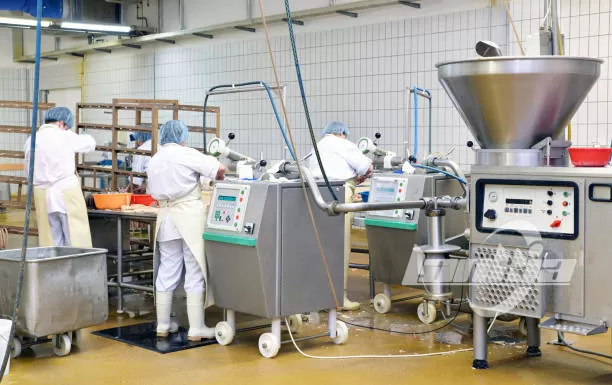
Automatic sausage production lines integrate equipment systems, including meat grinders, vacuum mixers, sausage stuffers, smoke ovens, and cooling systems. Each module is intelligently controlled via PLC, enabling continuous, high-efficiency production.
Key advantages include:
- High output capacity: Automated control systems maintain stable rhythms for sustained, efficient operation.
- Precision Consistency: Vacuum stuffing and quantitative control ensure uniform weight and length for each sausage.
- Labor Cost Savings: Minimal operator supervision is required per line, significantly reducing manpower investment.
- Hygienic Reliability: Food-grade stainless steel construction and enclosed conveying systems effectively prevent contamination.
- Traceable Production: The system automatically logs temperature, time, and batch information for easy quality tracking.
Lonkia's automatic sausage production line features a modular design that can be flexibly configured to meet customer requirements, ensuring efficiency while prioritizing maintenance and operational convenience.
Cost and Return on Investment Analysis
Although the initial investment for an automatic sausage production line factory is higher, long-term operating costs are significantly lower than manual methods.
- Labor Savings: Automation reduces labor expenses by approximately 70%.
- Reduced Waste: Raw material utilization increases by 5%-10%.
- Simplified Maintenance: Equipment boasts extended lifespan with longer maintenance intervals.
Typically, customers recoup their investment within 1-2 years of operation and continue to benefit from ongoing production efficiencies.
Conclusion: Automation is the Inevitable Trend in Sausage Production
For food enterprises seeking to expand capacity, reduce costs, and enhance brand image, automatic sausage processing lines represent the most cost-effective solution. They not only boost production efficiency but also ensure consistent quality in every sausage.
Lonkia will continue optimizing sausage processing equipment, delivering reliable designs and comprehensive after-sales service to provide customers with efficient, safe production solutions.