
When producing sausages at scale, the right equipment makes all the difference. Whether you run a small butcher shop, a mid-size deli, or a full-scale meat processing plant, selecting a high-quality sausage making machine ensures consistent product quality, boosts production efficiency, and reduces labor costs. In this article, we discuss what makes a sausage making machine “the best,” the types of machines available, and how to choose based on your needs.
Why Choosing the Right Machine Matters
Sausage production involves multiple steps — grinding meat, mixing seasonings, stuffing into casings, linking, and sometimes portioning. Mistakes or inconsistencies at any step can affect:
Flavor and seasoning balance
Texture and meat-to-fat ratio
Uniformity of sausage size and weight
Output speed and throughput
Food safety and hygiene
A high-performing sausage making machine helps standardize all these variables, leading to:
Uniform taste and texture batch after batch
Reliable portion control and size consistency
High throughput with minimal manual labor
Better hygiene thanks to stainless steel construction and easier cleaning
Types of Sausage Making Machines and Their Strengths
Below are common categories of sausage making machines — each optimized for different scales and needs.
1. Manual or Semi-Automatic Sausage Stuffers
These are entry-level machines suitable for small butcher shops or artisanal producers. Typically they include a hopper, piston plunger or lever system to push meat mixture into casings.
Strengths:
Low initial cost
Simple to operate
Good for small volume / custom batches
Limitations:
Requires manual effort
Slower output
Less consistent if manual loading and linking
2. Electric Sausage Stuffers & Semi-Automatic Fillers
These machines use electric motors or pumps to feed the meat mixture, reducing manual labor. They often include basic controls for speed and filling pressure.
Strengths:
Improved consistency over manual methods
Higher output speed
Easier handling of dense meat mixtures or mixtures with fillers
Good for: Small to medium production, deli shops, small factories
3. Fully Automatic Sausage Making Machines (Industrial Grade)
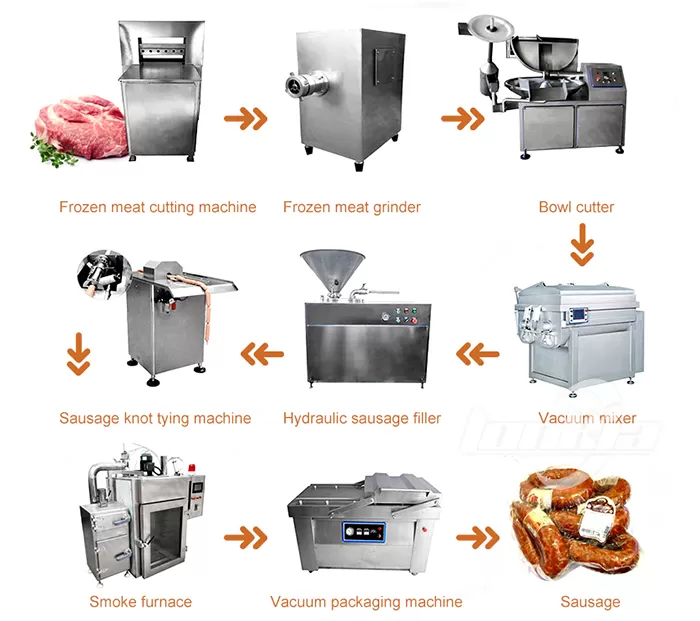
These advanced machines integrate grinding, mixing, stuffing, casing feeding, automatic linking (if needed), even portioning and cutting. For large plants, they may include vacuum systems to remove air bubbles and ensure tight filling.
Strengths:
Very high throughput (hundreds to thousands of kg per hour)
Consistent quality — uniform weight, texture, casing fill
Labor savings — minimal manual work required
Integration-friendly — can tie into larger production lines (cooking, cooling, packaging)
Best for: Meat processing plants, large-scale sausage factories, food manufacturers
What Makes a Sausage Machine “Best”: Key Features to Look For
When evaluating sausage making machines, these are the critical features that differentiate high-quality machines from average ones:
Stainless Steel Food-Grade Construction: for hygiene, durability, easy cleaning
Powerful Motor / Vacuum System: for dense or high-fat mixtures
Adjustable Filling Speed and Pressure: for different sausage types (fresh, smoked, dry-cured)
Consistent Portioning / Weight Control: to minimize waste, ensure uniform size
Automatic or Assisted Casing Loading / Linking (optional): improves efficiency and reduces labor
Easy Disassembly for Cleaning: important for hygiene and maintenance
Safety Features: like pressure relief, sealing mechanisms, overload protection
Choosing the Right Machine Based on Your Needs
Here’s a practical decision guide:
| Your Need / Situation | Recommended Machine Type |
|---|---|
| Small butcher shop / artisanal batches / custom sausages | Semi-automatic or electric sausage stuffer |
| Medium production volume, consistent output, deli shop supply | Electric sausage filler with adjustable controls |
| High-volume production, factory output, packaged sausages | Fully automatic, industrial-grade sausage making machine |
| Mixed product lines (fresh sausages, smoked, cured) requiring flexibility | Machine with adjustable pressure, casing compatibility, and optional linking |
Getting the Most Out of Your Sausage Machine
To ensure long-term performance and consistent output:
Maintain and clean regularly — stainless steel surfaces and internal parts must be sanitized after each batch
Use recommended operating pressures and speeds — avoid overfilling or high-speed stuffing that could compromise casing integrity
Match meat mixture consistency and particle size to machine capabilities — some machines handle coarse grind better, others are optimized for fine emulsions
Train operators — even a great machine needs skilled handling for best results
Consider resale volume and flexibility — sausage types and casing sizes may vary over time
Conclusion: Invest in Quality for Sustainable Production
For businesses serious about sausage production — whether artisanal butchers, local restaurants, or large-scale food manufacturers — investing in a quality sausage making machine is more than a convenience: it's a foundation for consistent quality, higher efficiency, and long-term profitability.
By choosing the right type — from a compact electric stuffer for small batches to a full-featured industrial line for high output — you ensure your products meet quality standards, production demands, and customer expectations.