
As the meat processing industry continues to evolve, an increasing number of food companies are turning their attention to automated sausage processing equipment. For customers new to the sausage processing industry, the choice of equipment not only affects production efficiency but also directly impacts product quality, labor costs, and the long-term operational stability of the facility.
Compared to traditional manual processing methods, automatic sausage production lines place greater emphasis on continuous production, product consistency, and equipment reliability. Therefore, it is crucial to understand the composition and core configurations of the entire production line before establishing a sausage processing plant.
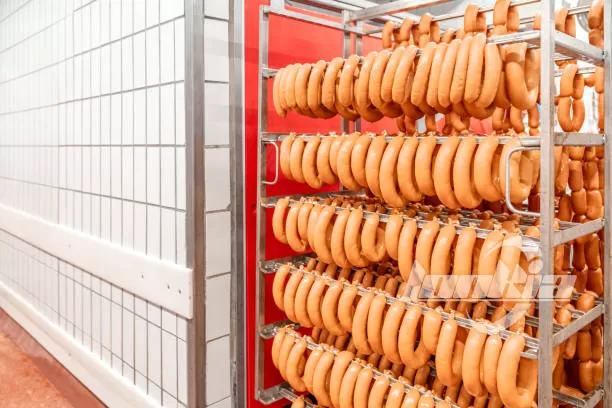
What Equipment is Included in a Sausage Production Line?
Modern sausage processing equipment typically consists of multiple core units, with each responsible for a specific processing stage.
These primarily include:
- Meat grinders
- Cutters
- Vacuum mixers
- Sausage fillers
- Automatic tying equipment
- Smoking ovens
- Cooling equipment
- Packaging equipment
Among these, meat grinders are used to process raw meat into uniform particles; cutters further enhance the fineness of the meat mixture, resulting in a more consistent product texture; and vacuum mixers minimize air ingress, improving the density and elasticity of the meat mixture.
The sausage filler is one of the key pieces of equipment in the entire automatic sausage production line. Automatic, metered filling not only improves production efficiency but also ensures greater uniformity in the weight and length of each sausage, reducing human error.
Why are More and More Factories Choosing Automatic Sausage Processing Equipment?
Automated sausage processing equipment is gradually becoming an essential component of modern meat processing plants. Compared to traditional manual production, automated equipment offers significant advantages in terms of production stability and efficiency.
Key advantages include:
- Reduced manual labor
- Improved production continuity
- Reduced product variation
- Enhanced product consistency
- Shorter employee training time
- Increased production efficiency
For example, automatic feeding systems reduce manual handling; PLC control systems enable centralized management of equipment operating parameters; and automatic filling and tying equipment ensures continuous, stable operation, boosting overall production capacity.
For factories engaged in long-term continuous production, equipment stability is particularly crucial. A stable production line not only minimizes downtime but also improves order fulfillment efficiency.
What Key Factors should be Considered when Purchasing Sausage Production Equipment?
Many customers often focus more on equipment price when purchasing sausage processing equipment, while overlooking the compatibility of the entire production line. In reality, the coordinated operation of equipment is a critical factor affecting production efficiency.
When purchasing, we recommend focusing on the following aspects:
1. Are the Equipment Capacities Compatible?
If the meat grinding speed at the front end is slow while the filling equipment at the back end runs too fast, it can easily lead to an unstable production rhythm. Therefore, it is crucial to properly configure equipment across all stages.
2. Do the Equipment Materials Meet Food Processing Requirements?
Currently, most food factories prefer to use 304 stainless steel equipment. This material is not only more durable but also easier to clean and maintain on a daily basis.
3. Ease of Disassembly and Cleaning
Food processing equipment requires frequent cleaning. Equipment with a well-designed structure that is easy to disassemble can effectively reduce the difficulty of maintenance.
4. Potential for Future Expansion
As production capacity increases, many customers will later add packaging, cooling, or automatic hanging equipment. Therefore, sausage production lines with a modular design are better suited for long-term development.
How to Choose the Most Suitable Sausage Making Machine?
Different sausage products require different processing methods. For example, fresh sausages, smoked sausages, and emulsified sausages all require distinct equipment configurations.
For instance:
- Smoked sausages require a smoking oven
- Emulsified sausages rely more on high-speed cutting and mixing equipment
- High-density products typically require a vacuum mixing system
- Continuous production is better suited for automatic filling equipment
Therefore, before purchasing sausage processing equipment, it is recommended to first clarify the product type, production process, and future development direction, and then formulate an equipment plan based on actual needs.
As a professional supplier of meat processing equipment, Lonkia can provide tailored sausage processing line configurations based on customers' product processes, production requirements, and factory layouts. From individual machines to complete production lines, flexible configurations are available to help customers establish more stable and efficient sausage processing workflows.