
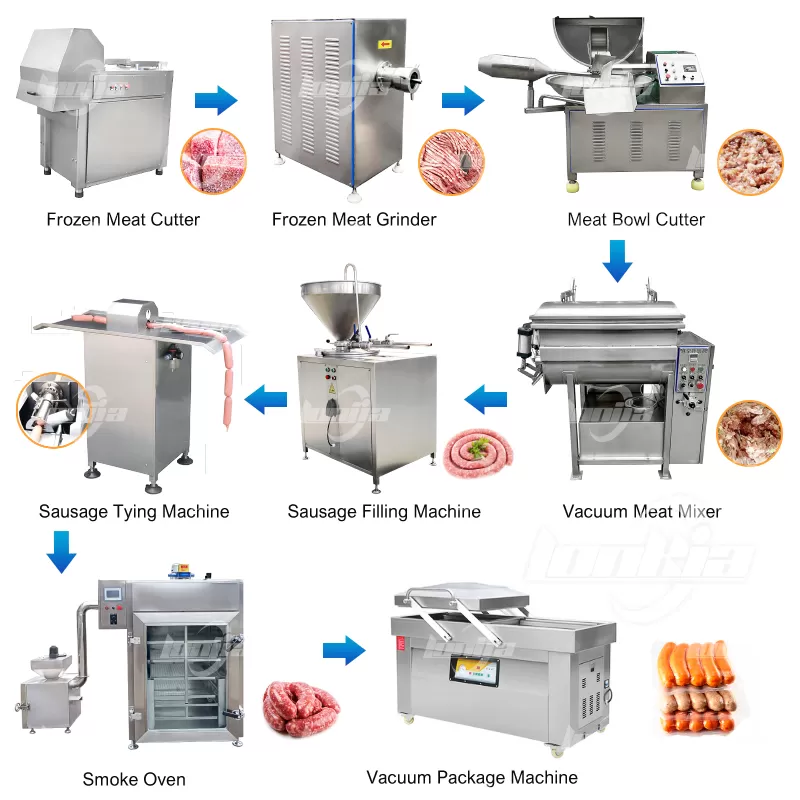
Cleaning and maintaining sausage making machines affects not only food safety but also operational stability, processing efficiency, and finished-product quality. Meat grinders, meat choppers, vacuum mixers, and filling machines have different structural characteristics, and their cleaning and maintenance methods also vary. Standardized equipment maintenance procedures help reduce food residue buildup, component wear, and unplanned downtime.
How Should Sausage Making Machine Be Cleaned on a Daily Basis?
1. Meat Grinders: Focus on Cleaning the Blades and Perforated Plates
After processing, meat residue tends to accumulate on the blades, perforated plates, auger components, and discharge area of meat grinders. Before cleaning, shut down the machine and disconnect the power supply according to the equipment manual. Confirm that the machine has completely stopped running, then have trained personnel disassemble the removable parts.
During cleaning, remove meat scraps and fat, and inspect the blades and perforated plates for wear, nicks, or blockages. When reassembling, ensure that components are correctly positioned and securely fastened to avoid compromising the mincing performance.
2. Cutter and Mixer: Inspect the Bowl and Blade Assemblies
The high-speed blade assemblies and tank edges of the meat grinder, as well as the paddles and discharge area of the mixer, are all areas prone to meat residue buildup. Pay special attention to these areas during cleaning to prevent residual material from affecting the next batch of products.
Disassembly and cleaning of blade assemblies must follow the manufacturer's specifications; never touch or clean the blades while the equipment is running. For vacuum mixers, also inspect the sealing components and vacuum lines according to the manual to prevent sealing issues after cleaning.
What Should Be Noted Regarding the Cleaning and Maintenance of Filling Machines?
1. Remove Meat Residue from the Filling Lines
The hopper, conveyor mechanism, filling tubes, and all parts of the filling machine that come into contact with the product should be cleaned promptly after production ends. Residual meat can cause line blockages, uneven filling, or difficulties during subsequent cleaning.
After cleaning, check that the filling lines are unobstructed and that seals are undamaged, and reassemble the equipment correctly according to the manufacturer's specifications. Disassembly and reassembly procedures vary by filling machine model; refer to the equipment manual for specific steps.
2. Inspect the Dosing and Drive Components
Routine maintenance should focus on the operating condition of the filling mechanism, connecting parts, and seals. If fluctuations in filling weight, intermittent discharge, or abnormal noise occur, check the condition of the meat mixture, equipment settings, and relevant mechanical components—rather than simply increasing the filling speed.
How to Develop a Sausage Making Machine Maintenance Plan?
1. Combine Daily Inspections with Periodic Maintenance
It is recommended to divide sausage processing equipment maintenance into three phases: pre-production checks, post-production cleaning, and periodic maintenance.
- Pre-production: Inspect equipment assembly, the condition of cutting tools, fasteners, and safety guards.
- Post-production: Remove meat residue, clean food-contact surfaces, and check for abnormal wear.
- Periodic maintenance: Inspect drive components, bearings, seals, and electrical systems according to the equipment manual; lubricate as specified or replace wear-prone parts.
Lubricants should be selected according to equipment requirements; lubricants that do not meet specifications must not be used in food-contact areas.
2. Establish Cleaning and Maintenance Records
Recording cleaning times, equipment abnormalities, component replacements, and maintenance personnel helps trace the causes of malfunctions and identify recurring issues early. For continuous sausage production lines, standardized records also help businesses schedule maintenance times, reducing the impact of unexpected downtime on production plans.
Consider Ease of Cleaning and Maintenance When Selecting Equipment
When purchasing sausage making equipment, in addition to focusing on production capacity and processing results, it is important to verify whether food-contact parts are easy to disassemble, whether cleaning areas are easily accessible, whether wear-and-tear parts are easy to replace, and whether the manufacturer provides clear maintenance instructions.
LONKIA sausage production lines can be customized based on product processes and equipment configurations. Confirming the cleaning methods, maintenance requirements, and spare parts support for each piece of equipment with the manufacturer prior to purchase helps establish equipment management processes better suited to actual production.
Conclusion
The reliable operation of sausage making machine depends on proper cleaning, regular inspections, and timely maintenance. Establishing specific maintenance requirements for different machines—such as meat grinders, cutters, mixers, and fillers—not only helps maintain processing quality but also reduces equipment failures and unnecessary downtime. Actual operations should always be based on the equipment manufacturer's manual and factory health and safety regulations.