
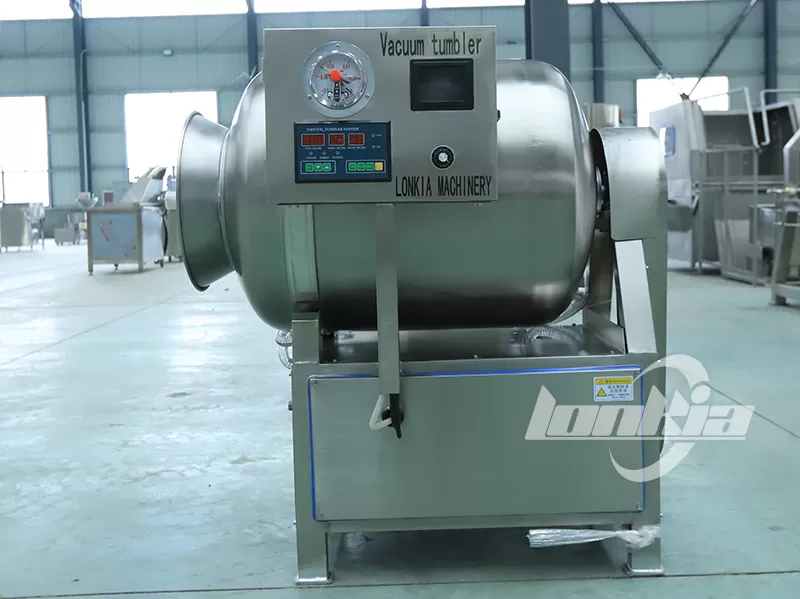
When selecting an industrial vacuum tumbler, many users tend to focus on the equipment's size or price, while overlooking the importance of proper capacity matching. In reality, whether the capacity is appropriate directly affects the tumbling results, production pace, and equipment utilization. Therefore, when choosing a vacuum marinade machine, it is essential to base decisions on actual processing needs and make a rational judgment.
The Relationship Between Capacity and Actual Production
The operating mechanism of an industrial vacuum tumbler dictates certain requirements for the load capacity. During operation, the equipment relies on the rotation of the drum to cause the materials to tumble and interact with one another. If the load is too heavy, the limited space for the materials will affect the uniformity of the curing process; if the load is too light, the equipment's operational efficiency will be low.
It is generally recommended to operate the equipment at around 60% of its rated capacity to balance efficiency and effectiveness. This range ensures that the materials have sufficient space to move, thereby achieving a stable tumbling state.
Preliminary Assessment Based on Daily Processing Volume
Capacity selection can start with daily processing volume. A simple approach is to first determine the total daily raw material volume to be processed, then calculate the required capacity based on the processing time per batch.
For example:
If 300 kg of raw material needs to be processed daily, and a single tumbling cycle takes approximately 30 minutes, you can calculate the number of required batches based on production shifts and then determine the appropriate capacity for a single unit.
Generally:
Equipment capacity (L) ≈ approximately 1.5 times the weight of a single batch (kg)
This ensures sufficient space is reserved for the tumbling process.
Variations Due to Different Materials
In practical applications, different types of meat require varying capacity specifications.
- Smaller cut ingredients are easier to tumble, so the loading ratio can be appropriately increased.
- Larger-volume ingredients require more ample tumbling space.
- For products requiring high uniformity of flavor penetration, it is recommended to reduce the loading ratio.
Therefore, even for the same industrial vacuum tumbler, its effective processing capacity will vary depending on the specific product conditions.
Allowing for Some Operational Margin
Equipment is typically not intended to serve only current orders; future production changes must also be considered. If the capacity is chosen to meet current needs barely, equipment shortages may occur once production volume increases.
In actual configuration, it is advisable to reserve some additional space—for example, by adding a margin to the current demand. This approach helps extend the service life of marinating tumblers and reduces costs associated with future adjustments.
Factors to Consider Beyond Capacity
While capacity is a key parameter, it is not the sole criterion. During the selection process, the following aspects should also be considered:
- Stability of the vacuum system
- Adjustment range of drum rotation speed
- Equipment structure and materials
- Ease of operation of the control system
These factors collectively influence the user experience. For instance, the industrial vacuum tumblers provided by Lonkia feature relatively stable construction and control systems, making them suitable for standard processing needs.
Summary of Simple Evaluation Methods
In the absence of complex calculation requirements, you can follow these steps for evaluation:
- Determine the daily processing volume
- Estimate the batch processing volume
- Select equipment capacity based on a 1.5x multiplier
- Maintain a reasonable loading ratio
- Allow for adequate operational space
By following this approach, you can select a suitable capacity range for most scenarios.
Conclusion
Selecting the capacity of an industrial vacuum tumbler essentially involves matching production rhythms with processing methods. A reasonable capacity not only helps improve tumbling effectiveness but also ensures more stable equipment operation. During the selection process, making decisions based on actual needs is more meaningful than simply pursuing specific technical parameters.