
As demand for processed meat products continues to grow, sausage manufacturers are looking for ways to increase production while maintaining consistent quality. An industrial sausage making machine provides an efficient solution for businesses that need higher output, better product consistency, and reduced labor requirements.
For small meat processors, commercial kitchens, and large sausage production plants, investing in suitable sausage processing equipment can improve both daily operations and long-term profitability.
What Is an Industrial Sausage Making Machine?
An industrial sausage making machine is designed to automate key stages of sausage production, particularly meat filling and sausage forming. Depending on the production line, the equipment can work with meat grinders, mixers, vacuum fillers, linking machines, and other processing equipment.
Industrial sausage machines are commonly used for:
fresh sausages
smoked sausages
cooked sausages
meat sticks
specialty sausage products
The machine configuration can be selected according to product type, casing material, and production capacity.
Increase Production Efficiency
One of the biggest benefits of an industrial sausage making machine is higher production efficiency.
Manual sausage filling is slow and difficult to maintain at a consistent speed. Automated equipment can continuously process large quantities of meat, allowing manufacturers to increase output without proportionally increasing their workforce.
This makes industrial sausage equipment particularly valuable for high-volume production.
Improve Sausage Weight and Size Consistency
Product consistency is important for both quality control and customer satisfaction.
An industrial sausage filling machine can provide more accurate portion control, helping manufacturers maintain consistent:
sausage weight
diameter
length
filling density
Consistent products are also easier to package and price, which can reduce production losses.
Reduce Labor Requirements
Traditional sausage production often requires several workers to perform filling, portioning, and linking tasks.
Automated machinery can handle many repetitive operations, allowing manufacturers to reduce manual labor and assign employees to more valuable production tasks.
Lower labor requirements can also help businesses manage rising labor costs.
Improve Product Quality
An industrial sausage making machine provides controlled filling pressure and consistent processing conditions.
This helps reduce common problems such as:
air pockets
uneven filling
inconsistent sausage size
casing damage
Better control during production results in a more uniform finished product.
Improve Production Hygiene
Food hygiene is a critical consideration in meat processing. Industrial sausage equipment is designed to make cleaning and sanitation easier.
High-quality machines commonly use stainless steel construction and hygienic processing surfaces. Equipment with simple structures and accessible components can also reduce cleaning time and maintenance requirements.
Support Different Sausage Products
Modern sausage processing equipment can often be configured for different products and casing types.
Depending on the machine, manufacturers can process:
natural casings
collagen casings
cellulose casings
This flexibility allows businesses to expand their product range without completely changing their production system.
Reduce Product Waste
Accurate filling and portion control can help reduce unnecessary meat waste.
When the filling process is inconsistent, manufacturers may experience overfilling, underfilling, or casing breakage. Automated sausage equipment provides more precise control, helping improve raw material utilization and production efficiency.
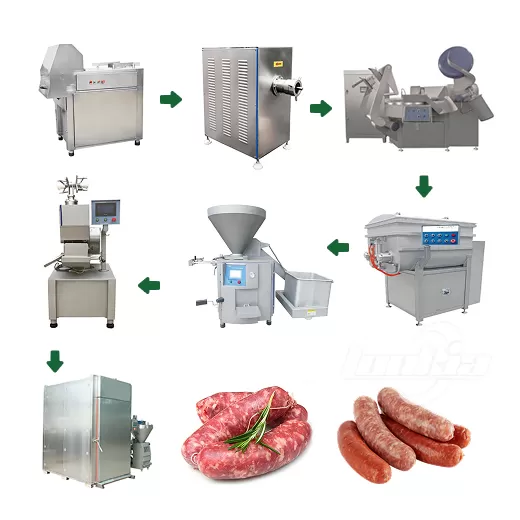
Easy Integration into a Complete Sausage Production Line
An industrial sausage making machine can be integrated with other meat processing equipment to create a complete production line.
A typical sausage processing line may include:
meat grinder
meat mixer
vacuum sausage filler
sausage linker
cooking or smoking equipment
cooling system
packaging machine
Integrating equipment into a continuous workflow can further improve production efficiency and reduce manual handling.
How to Choose the Right Industrial Sausage Making Machine
Before purchasing, consider several important factors:
required production capacity
sausage type and size
casing type
filling accuracy
level of automation
machine construction
cleaning and maintenance requirements
A small sausage producer may only need a compact commercial machine, while a large meat processing plant may require a high-capacity automatic filling and linking system.
Why Choose LONKIA Machinery?
LONKIA Machinery provides industrial food processing equipment for meat processing businesses looking to improve production efficiency and automation.
Our sausage processing solutions can be customized according to production capacity, product requirements, and factory layout. From individual sausage machines to complete processing solutions, LONKIA Machinery can help customers select suitable equipment for their production needs.
Conclusion
Investing in an industrial sausage making machine can bring significant benefits to meat processors, including higher production capacity, consistent product quality, lower labor requirements, improved hygiene, and reduced material waste.
The right machine should be selected based on your production volume, sausage specifications, automation requirements, and future expansion plans. With the right equipment and a properly designed production process, businesses can improve efficiency while producing consistent, high-quality sausages for their customers.