
In the meat products industry, production capacity stands as one of the core metrics most closely monitored by customers. As market demand continues to grow, companies often need to upgrade their sausage processing lines to handle larger order volumes while maintaining product quality and production efficiency. For food processing enterprises, scientifically and rationally enhancing production capacity is a critical challenge that directly impacts profitability and competitiveness.
Key Factors in Capacity Enhancement
The overall efficiency of a sausage production line depends on the coordination of multiple stages. These typically include meat grinding, mixing and seasoning, vacuum filling, automatic linking, cooking or smoking, cooling, and packaging. If any stage operates too slowly, it becomes a bottleneck for capacity expansion. Therefore, when considering upgrades, customers must comprehensively evaluate the processing speed and compatibility of each stage. For instance, upgrading to high-speed sausage filling machines can achieve greater filling efficiency per unit time, while implementing automatic linking equipment reduces manual labor and maintains production continuity.
Advantages of High-Speed Vacuum Filling
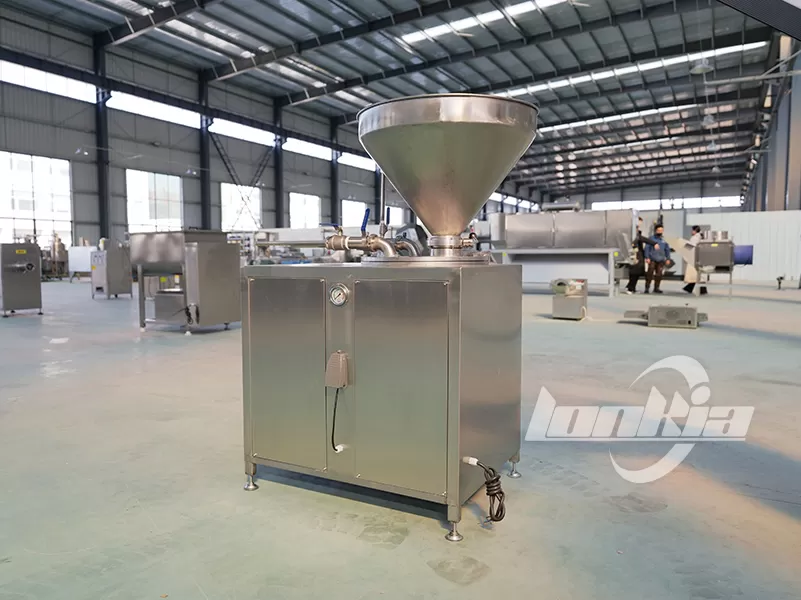
Vacuum sausage filling machines are critical equipment in the sausage production process. High-speed vacuum fillers not only rapidly complete precise filling but also ensure uniform filling density, prevent air bubble formation, and enhance sausage texture and appearance. Upgrading this equipment significantly increases hourly output while reducing scrap rates caused by air bubbles, leading to more stable and reliable production.
Integration of Automation and Intelligence
With technological advancements, sausage processing lines increasingly embrace automation and intelligence. Through PLC control systems and sensor monitoring, real-time tracking of production data enables precise regulation of parameters like temperature, pressure, and speed. This intelligent upgrade not only boosts output but also triggers rapid alerts and adjustments during anomalies, preventing extensive downtime losses. For enterprises prioritizing efficient, stable production, such upgrades are essential.
Enhancements to Cooling and Packaging Systems
During capacity expansion, cooling and packaging stages are often overlooked. Yet rapid cooling systems reduce waiting times, ensuring products reach packaging faster; automated packaging equipment enables continuous operation with minimal manual intervention, guaranteeing efficient shipment of finished goods. Upgrading these segments streamlines the entire production chain, preventing bottlenecks where earlier stages operate quickly while later stages lag.
Value Delivered by Comprehensive Upgrades
By upgrading key equipment, customers not only achieve higher output but also attain greater consistency and standardization, minimizing human error in production. Brands like Lonkia design sausage production lines with modularity and flexibility, anticipating future capacity expansion needs. This enables swift adjustments during future growth, reducing secondary investment costs.
Conclusion
Upgrading a sausage processing line transcends mere equipment modification; it represents comprehensive process optimization and systemic enhancement. Whether through high-speed vacuum filling, automated chaining, intelligent control, or advancements in cooling and packaging systems, these upgrades are vital tools for achieving higher output and efficiency. Through strategic upgrades, enterprises can maintain competitive advantages in a fiercely competitive market while meeting ever-growing consumer demand.