
When purchasing meat processing equipment, there is often a significant variation in the prices of bowl chopper machines. Prices range from a few thousand to tens of thousands of dollars, leaving many customers confused when selecting a model: why is there such a marked price difference between machines that appear similar? This article will systematically analyze the core factors influencing price, helping you make a more rational investment decision.
The Function and Value of Bowl Chopper Machines
The meat bowl cutter is primarily used for mincing, emulsifying, and mixing meat. Through the coordinated action of high-speed blades and a rotating bowl, it transforms raw materials into a fine, uniform meat paste. This equipment significantly enhances product texture, yield, and consistency, making it a critical component in the production of sausages, meatballs, and similar products.
Additionally, high-speed cutting and rapid processing effectively control temperature rise, thereby maintaining protein structure stability and improving product quality.
Key Factors Affecting the Price of a Bowl Chopper Machine
1. Equipment Capacity and Production Capacity
Capacity is the primary factor determining bowl cutter price. Common equipment specifications range from 20L to 330L or even higher, with different capacities directly corresponding to different production capacities.
For example:
- A 20L machine processes approximately 10 kg per batch
- An 80L machine processes approximately 40 kg
- A 125L unit can process over 60 kg
Larger capacity requires greater structural strength, higher motor power, and increased overall costs, resulting in a higher price.
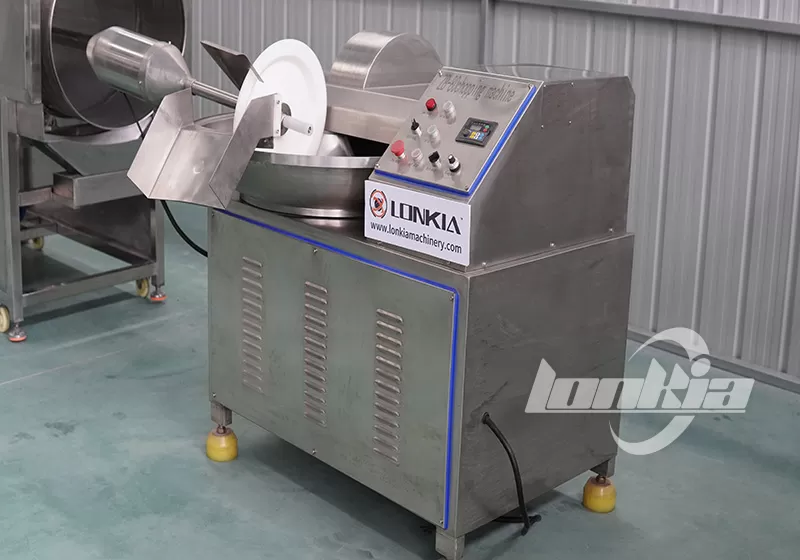
2. Motor Power and Blade Speed System
Meat bowl choppers rely on high-speed blades to achieve emulsification. Higher blade speeds produce finer cutting results but also demand superior motor performance.
High-end equipment typically features:
- Multi-speed blade adjustment
- High rotational speeds (3000–6000 rpm)
- Stable load capacity
These configurations directly impact equipment performance and price levels
3. Materials and Manufacturing Processes
The main body of the bowl chopper machine is typically constructed of stainless steel; different material grades affect both price and service life.
- High-quality stainless steel: corrosion-resistant, easy to clean, long service life
- Standard materials: lower cost but poorer durability
Over the long term, high-quality materials reduce maintenance costs, making them a key factor in price differences.
4. Automation and Feature Configuration
The higher the level of automation, the higher the equipment price. Common configurations include:
- Variable frequency drive (VFD)
- Automatic discharge system
- Vacuum system (anti-oxidation)
- Programmable control panel
For example, equipment with a vacuum system reduces air ingress and improves product quality, resulting in a significantly higher price compared to standard models.
5. Brand and After-Sales Support
A brand influences not only bowl cutter price but also reliability and service. Established brands typically offer:
- More stable operational performance
- More comprehensive after-sales service
- Longer service life
For long-term manufacturers, such equipment represents a better investment.
Reference Range for Meat Bowl Cutter Price
Based on market data, bowl cutter prices are generally as follows:
- Small-scale equipment: approx. $1,500 – $3,000
- Medium-scale equipment: approx. $5,000 – $15,000
- Large-scale equipment: $15,000 and above
It is important to note that prices depend not only on specifications but are also closely related to configurations and customization requirements. If you would like to know the actual price of a machine, please feel free to contact us at any time.
How to Select the Right Equipment Based on Your Budget?
When making a purchase, it is not recommended to base your decision solely on bowl cutter price. Instead, consider the following factors:
- Actual production capacity requirements (kg/batch)
- Product type (emulsified/granular)
- Automation requirements
- Room for future expansion
For example, if your production requires consistent emulsification results and continuous output, choosing a higher-specification machine often offers greater long-term value than a lower-priced model.
Summary
The price of a bowl chopper machine is fundamentally determined by a combination of production capacity, performance, configuration, and manufacturing quality. Understanding these factors can help you avoid low-price traps and select equipment that truly meets your production needs.
In practical applications, equipment suppliers like lonkia can typically provide customized solutions based on the customer's production capacity requirements, thereby achieving a more reasonable balance between cost and performance. If you need advanced equipment to improve the efficiency of your processing plant, please contact us immediately.